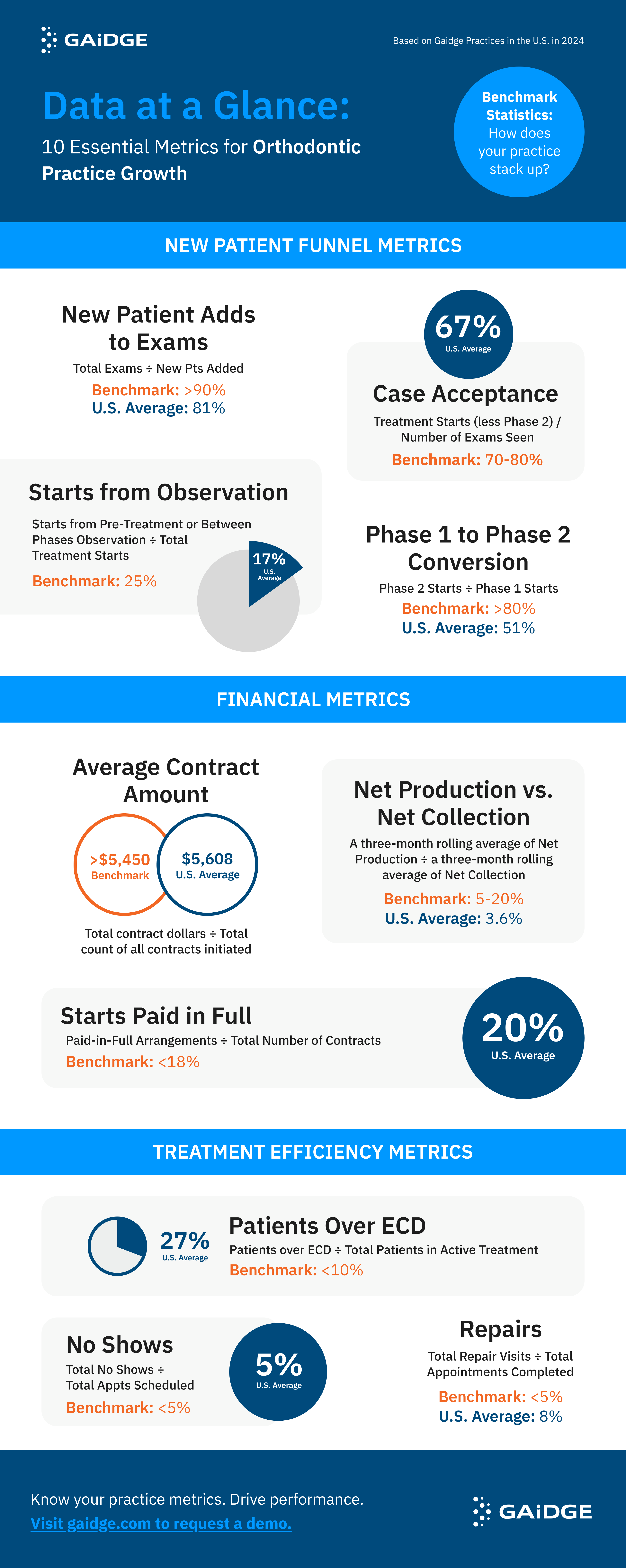
Data at a Glance: 10 Essential Metrics for Orthodontic Practice Growth Infographic

FAQs
What are the most important orthodontic growth metrics to track?
Track a tight set that covers your funnel (leads, exams, starts), revenue health, and operational drag: New Patient Adds to Exams, Case Acceptance, Starts from Observation, Phase 1 to Phase 2 Conversion, Average Contract Amount, Net Production vs. Net Collection, Starts Paid in Full, Patients Over EDC, No-Shows, and Repairs.
How do you calculate New Patient Adds to Exams, and what’s a strong benchmark?
Formula: Total Exams ÷ New Patients Added.
Benchmark: >90% (infographic lists a U.S. average of 81%). If you’re low, tighten speed-to-schedule, confirmation/reminders, and remove friction before the first appointment.
How do you calculate case acceptance rate, and what should you aim for?
Formula: Treatment Starts (less Phase 2) ÷ Number of Exams Seen.
Benchmark: 70–80%. To improve it, standardize financial options, shorten time from exam to start, and build a consistent follow-up process for “not today” patients.
What does Net Production vs. Net Collection measure, and what’s a healthy range?
It shows how well you’re converting produced revenue into collected revenue using a rolling 3-month view.
Formula: 3-Month Avg Net Production ÷ 3-Month Avg Net Collection.
Benchmark: 5–20% (infographic lists a U.S. average of 3.6%). If you’re under target, focus on AR follow-up, autopay adoption, failed-payment workflows, and insurance aging.
What efficiency metrics matter most (Over EDC, no-shows, repairs), and what are the benchmarks?
These metrics highlight where schedules and chair time are lost: Patients Over EDC, calculated as Patients Over EDC divided by Total Active Patients (with a benchmark of less than 10% and a U.S. average of 27%); No-Shows, calculated as Total No-Shows divided by Total Appointments Scheduled (benchmark less than 5%); and Repairs, calculated as Total Repair Visits divided by Total Appointments Completed (benchmark less than 5%, with a U.S. average of 8%). If any of these rates are high, it’s important to tighten appointment confirmations, reduce breakage through patient education, standardize emergency visit criteria, and audit clinical causes of extended treatment.
References